Theism.net
Options: home |
articles | books | search | webmaster
.gif)
e-mail: jordantheistDELETETHIS@bellsouth.net
Birth and Death of an Atheist
G. Zeineldé Jordan, Se.
(http://www.theism.net/authors/zjordan)
(Updated
November 2004)
No
copyright is enforced.
I will
never be the same again. I will never return. I’ve closed the door. I will walk
the path. I’ll run the race. And I will never be the same again.
-Hillsongs of Australia
Throughout my life, I observed people behaving
differently in church than in daily living. I found such hypocrisy all too
common in church-going Christians. I also observed they would accept "sin"
in their lives, confess it or answer an altar call on Sundays, then continue it
the next week. That taught me sin was preferable over God’s design. I deduced
God might not even exist; if He were real, people would not discard Him as they
exited church doors. If God did exist, His design for man evidenced flaws. I
had my own design: sex, drugs, rock ’n’ roll, and a little bit of country.
In doubting God’s existence, I began doubting
Christ’s historical existence. Let us face it: it is the most awesome story
ever told. It is awesome beyond the basic resurrection aspect inasmuch as it
represents love, forgiveness, and acceptance beyond man’s comprehension. After
all, my high school education included "facts" about human origin
conflicting with the "Holy Book." My secular government education
taught me many things opposite biblical teachings. By my early twenties, I
simply did not believe the gospel message. Many times people asked me how I
could not believe in God. Such people amazed me. Why the confusion?
"I don’t believe it," I would answer.
"I think it’s a fairy tale with moral teachings intertwined”. Further, I
often said, "I think the Bible is used for milking money from the masses
and controlling their minds and behavior".
I would say that as if I had some grip on
controlling my mind and behavior. The fact of the matter is that my drug
addiction had seized control of mine. I experienced continued failures the
following years. In the end, when my size 30 pants grew baggy on me, and my
eyes were ringed in that which remained of my eye sockets, I had failed my
travel business, my clients, my family and friends, and my creditors. One drug
buddy, Eddy, put a gun to his head and ended his agony. I considered following
suit. Other drug buddies had either over dosed or were in prison.
One day, I took a ride, a long ride, up the California coast. I thought a lot, a whole lot. Still high as a kite
on speed, I was arrested and the car impounded. I had lots of time to think
throughout my stay in that northern California "County
Hilton" that almost two-decade ago trip. More importantly,
I had time to cry. For the first time in many years, I managed to shed a tear.
Then I shed more, and more, and more. I thought of every person I had harmed.
If tears had never "made the man," they made this one that day.
Possessing nothing but shame, disgrace, and
unpaid bills, I appeared at Ma’s doorstep. She and my brother Tony nursed me
back to health. I did not work for weeks. I ate, slept, and read. I survived.
My drug addiction was behind me, and it has stayed there since. Praise God.
I had always enjoyed reading, particularly
history. I found American history especially tantalizing. The more history I
read, the more I despised Christians. I learned of my ancestors, the Portuguese.
I learned of their conquering and enslaving African tribes, and their brutal
treatment of peaceful natives who welcomed them as friends. Apparently, their
Catholicism failed to circumvent their evil nature. I learned of the Spanish
conquistadors doing the same in South
America, and of the Spanish and
Italian Inquisitions robbing the masses in the name of the church and Jesus
Christ. I learned of the English Crusaders conquering, raping, and pillaging
distant lands and claiming their spoils in the name of Christ. I read about America’s Christians massacring American Indians who had welcomed
them with open arms. Surely, I wanted no part of the evils of what following
Christ represented. Christianity repulsed me. I was so repulsed I chose to
battle it. I grew outraged at Christianity. I felt conned.
At age 28, I joined American Atheists, a national organization of like-minded
infidels. I learned so much that soon I banned Bibles from my home. Someone
could enter my home with muddy shoes, but Bibles had to be left at the door.
I described myself as philosophically agnostic,
for I believed there is not enough evidence to prove or disprove the existence
of God, and a practicing atheist, meaning I lived on the premise no God
existed. As far as an outright label, I identified myself as a
"freethinker." I retain that label today, second only to
"Christian."
American Atheists offered me an outlet from which
to spew forth my venomous anger about Christianity. American Atheists rented
space at the Arizona State Fair in 1990, which provided me an opportunity to
vent my anger publicly.
After a personal encounter with American Atheists
president Madalyn Murray O’Hair, I decided American Atheists was not worthy of
my time and energy. I sensed ugliness and evil in her that her printed
materials masked. I canceled my membership.
For family reasons, I relocated from Phoenix, Arizona, to Marietta, Georgia, in 1991. There I met up with the Atlanta Freethought Society (AFS), another group of infidels. It was a local chapter of the
national Freedom from Religion Foundation
(FFRF).
FFRF seemed to offer what I pursued. I strongly
desired to be a part of Christianity’s destruction. I wanted to contribute my
small part in "restoring the wall of separation between church and
state," a wall I would later learn was nonexistent. It was merely a phrase
coined by America’s third president, Thomas Jefferson, in a letter to a
Baptist congregation assuring them the federal government had no power to
interfere with their religious practices.
The AFS seemed to offer the ideal activism. Their
first pro-active event after I joined them was to display a banner in the
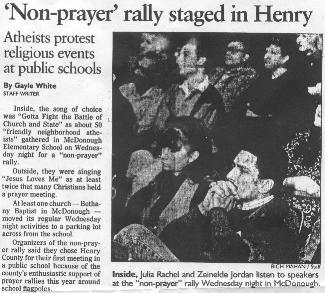
park on the square in McDonough, Georgia in 1991. Being there made me feel a part of the educating
of America. The event made national news.
One problem I encountered with atheistic
organizations is that they seemed to require a religious reverence for their
non-religion. When O’Hair visited Phoenix for a solstice celebration, members argued over which
blessed atheist would buy her dinner, drive her
around, lay out red carpet, etc. Her papal arrival had me wonder if I could
cure my cigarette smoking addiction by touching the hem of her garment.
I let my AFS and FFRF memberships lapse because I
tired of the continued bickering amongst members about what
"freethought" should mean. The local AFS chapter later severed its
tie with the FFRF after its president, Tom Malone, pouted over a disparaging
remark made by the FFRF. Later, other members split off to form Humanists of Georgia, while others stayed behind to argue
about trivial matters as if they were of national interest. I would join again,
lapse again, and so on. I grew unfavorably impressed by how the
"intellectual elite" couldn’t seem to get along even on a local
level. I often described them as the "Catholics and Baptists going at it
again."
I did not like Christians, and I would have
nothing to do with someone once I learned of their Christianity. Then in 1992 I
met a man named Jim. I learned of his Christianity, but I liked him anyway. I
respected his honesty, intelligence, and good character. We became friends despite
our disparate theistic positions. He made an example of not condemning, but
trusting his light to shine onto me. That shocked me because I had grown
accustomed to "religious fanatics" attempting to force other people
to conform to their religiosity or spewing forth condemnation on dissenters.
Jim accepted me as a friend and left the rest of the work to the "Holy
Spirit." His attitude and obedience to the Lord opened the door for
someone else who would show me just who Jesus Christ really was, is, and will
always be.
It happened one day as I scanned the radio dial.
I came across an argument between an atheist and a Christian. The Christian was
former U.S. Congressman-turned-radio-talk-show-host Patrick L. Swindall. The caller
expressed his venomous anger towards Christians. The host behaved much like my
friend Jim. The Christians I usually heard debating atheists cut off callers
very quickly when the callers spoke outside a "Praise the Lord"
direction. Not that Swindall fellow, though. He treated the caller with utmost
respect and patience. To me, Swindall won the debate hands-down merely because
of his manner. I listened to the rest of his show. Then I listened daily. His
politics intrigued me. Every political solution he espoused met the concerns of
atheist activists and honored the rights of Christians. I grew to admire
Swindall. I eventually sent him a letter commending him on his show, his
politics, and his religiosity. He responded with an invitation to my wife, Vickie,
and me for lunch, and drove half way across the Atlanta metropolis to meet us. He shared his personal testimony.
He did not convince me of God’s existence at that luncheon, but he demonstrated
true Christian outreach. I grew so impressed with his politics and religiosity
I decided to write about him, for I felt even we
atheists should support his show and, ideally, his run for a return to office,
if ever he decided to run again; hence, the birth of Perjurer or Saint? (A Freethinker Introduces Pat Swindall). I titled it such
because Swindall had been charged and convicted of perjury in a case my lay
investigation convinced me was a frame job to remove him from office. The more
I looked into his innocence, the more certain of it I grew. More importantly,
the more I looked into his case, the more I learned about the Jesus Christ
Swindall worshipped.
In
my research (for Perjurer or Saint?), I closely examined Christian and
atheistic political propaganda. I compared those two versions of American history.
To illustrate that America’s history is being rewritten, I include the
following excerpt from my manuscript:
The
atheists, Ed and Michael Buckner cited a 1975 edition of National Geographic
as their source in citing Benjamin Franklin’s words in their publication Quotations
that Support the Separation of State and Church (1993, page 27).
I
believe in one God, Creator of the universe . . . . That the most acceptable
service we can render Him is doing good to His other children . . . . As to
Jesus . . .I have. . .some doubts as to His divinity.
In America’s
Real Religion, Gene Garman (1994,
page 110), presents the same quotation citing Albert Henry Smyth’s Writings
of Benjamin Franklin (1905). The omitted phrases follow.
After
universe: ". . . that He governs it by His providence. That He
ought to be worshipped."
After
children: "that the soul of man is immortal."
After
As to Jesus: " . . .of Nazareth . . . I think the system of
morals and His religion, as He left them to us, the best the world ever saw or
is likely to see."
After
I have: " . . . with most of the present dissenters of England."
In
the Buckners’ defense, they presented other Franklin quotations expressing a
value for religion. Quite possibly, the omission came from their source, and
they merely trusted it.
Patrick
L. Swindall’s personal relationship with his Lord and Savior ultimately changed
my life, literally forever. His example of walking closely with his Lord, yet
honoring the rights of non-believers, sang to my political soul.
G.
Zeineldé Jordan began changing. I changed so much I submitted an article to the
AFS newsletter entitled My Appeal to the
AFS. I did not expect it to make print. I was right, but I felt good that I
made an attempt to open some eyes. I charged AFS with committing the same poor
ethics they charged Christians with, such as using government-funded (public)
schools for proselytizing their religious faith (Humanism).
I reminded the AFS I was a member because I opposed religious tyranny,
including our anti-theistic religious tyranny. I claimed they rejected a God of
spirit only to embrace a God of government. They applied a double standard in
what they battled Christians about because, after all, they "had it
right."
At
that point, despite my lack of belief in the existence of God, I decided the
Christian movement in America was worthy of support. My "net results"
orientation led me to question America’s current state of affairs. I had no
doubt America was better off when up was up, down was down, good was good, and
bad was bad. It became clear to me that America’s revolutionary morals shift of
recent decades produced infanticide, fatherless children, increased drug use,
and violence in classrooms.
Then a
friend of a friend put Tim LaHaye’s Battle for the Mind in my hands.
LaHaye did not convince me a God existed, but he clearly depicted I believed
what I believed merely because I had been indoctrinated.
In an
attempt to gain cross-cultural insight, I decided to visit a Christian church.
I was convinced I could better understand Swindall’s religiosity by witnessing
a Christian congregation first-hand. I chose West Cobb Baptist Church because I
knew a member. I enjoyed the service and the sermon. A few days later, its
pastor, Scott Beasley, and a church member visited us. We had a delightful time
with them. They appeared quite sane. The congregation drew Vickie (also a
philosophical agnostic and practicing atheist). She expressed a desire to
return. I consented. I encountered none of the "religious fanatics" I
expected to encounter. The congregation exhibited warmth, love, and, to use
Vickie’s term, a "fuzziness." We continued our learning expedition
for seven weeks. I experienced serious intellectual battles over the
attraction. I felt my brain would break at any moment because the sermons were
making sense. However, to accept such realities meant to discredit all of my
cherished beliefs. Also, what I had been hearing on the Pat Swindall show about
theism kept validating the sermons in practical terms.
When
Jim learned of my West Cobb Baptist Church visitation, he supplied me with a
New King James Version Bible to use as a reference source to review scripture
first-hand. A Bible finally made its way to the Jordan library. I used it to
look up scripture referenced in my atheist literature and "Pastor Scott’s"
sermons.
Vickie
and I discussed Christianity and Jesus almost every night throughout our seven
weeks of church visitation. One evening, I confessed to Vickie that despite my
years-long venomous disgust toward Christians, I had to admit, "Anything
that Jesus fella actually said or did is not particularly offensive. It is what
has been interpreted about it that is harmful." I went on to deduce,
"Vickie, it reminds me of the old saying, ‘The only thing wrong with
Christianity is not that it has failed, but that it has never been tried.’ That
statement was actually made in opposition to Christianity but let’s examine it.
Christians claim this Christ fella is without blemish. They worship Him and claim
no one can match His purity. Actually, if there is any truth to the Bible, it
demonstrates the conquistadors and other barbarians would need that Christ
figure. I have to ponder this further because, viscerally, I am beginning to
think that Jesus fella took a bad rap, and sadly, mostly because of those who
claim to follow Him. After all, I have always admired Mark Twain’s claim that
‘If Christ were real, there is one thing He would not be, and that is a
Christian.’"
I
considered perhaps He would be -- a God?
"At
this point, I would be lying to you, myself, that congregation, and their God
if He exists, if I were to claim I don’t believe that congregation has
something from on high. I’m not saying I believe in a God, or I can
anthropomorphize that force. I’m saying there’s more to it than I have
knowledge to explain. Don’t expect me to run up the altar. However, they
deserve a new respect."
Vickie
responded with, "You realize if that Jesus is anything, He is
everything." Her observation stuck with me unshakably.
I
obsessed over Christianity and atheism. I disliked what was happening. I began
thinking I had been wrong and had unfairly blamed Jesus Christ for what humans
had done in His name. I felt somewhat shamed and remorseful. After great
agonizing and investigating, I determined:
1.
Unconstitutionally, Secular Humanism is America’s governmentally established
religion despite the "wall of separation" value secularists espouse.
I devoted years of support to organizations that professed to be protecting
that wall, while in practice were actually forcing a non-theistic religion onto
the public.
2.
Humanists control mainstream media, politicians, and the entertainment
industry.
3. Religiosity
was a factor in America’s history. That history has been re-written or omitted
in some public [government-run] schools. For example, some public school texts
omit George Washington’s religious references from his Farewell Address.
4.
Currently, American governmental entities have grown totalitarian and coercive,
whereas Jesus still seeks voluntary hearts.
5.
Jesus endured attacks from His corporeal visit through today yet survives.
Christianity flourished against all odds.
6.
Jesus’ teachings do not support the Christian atrocities I have condemned
throughout my atheism. Jesus should not be charged for those atrocities.
Further, atheistic regimes have committed equally and worse atrocious acts in
the name of "the people." Both atrocious histories merely demonstrate
just how much Christ’s teachings are needed.
7. I
reject the idea the apostles allowed themselves to be persecuted over something
they knew to be false. I also reject that the apostles and the 500 witnesses to
His ascension into Heaven experienced joint hallucinations. Science has yet to
prove such hallucinations are possible. The apostles had everything to lose by
practicing their faith and nothing to gain. Cultists are convinced of a future
happening; W.W.II Japanese kamikaze pilots (similar to other religious and
political martyrs) were youth indoctrinated from birth regarding the Empire/God
unity concept. The disciples were neither cultists nor kamikaze styled
religious fanatics, for they were steadfast over something they personally
witnessed.
8. If
Jesus and His apostles (authors of the New Testament) existed and were
truthful, His absent body is beyond secular explanation if kept in harmony with
secular explanations for His followers’ visions. If Jesus and His disciples did
not exist, who wrote the New Testament and why? I reject that some loonies
wrote it, then ignoramuses followed their insanity for 2000 years. There had
been other virgin births and saviors in actual religions that died. Why would a
fantasy version live on? Why would lives be changed by it?
9. Bible
prophecies have come to pass against enormous odds.
10.
Women are not the subjugated male-inferiors that non-Christians perceive the
Bible teaches. Husbands are to sacrifice themselves for their wives as Christ
did for the church (Ephesians 5:25).
With
those 10 points in mind, I further determined that, even if Jesus had been a
mere man, I could support His teachings with vigor and zeal, if the
supernatural aspects were applied figuratively. Later, I questioned whether I
was correcting the teacher by omitting the supernatural of which He spoke.
Still fighting it, I owned up that following is following, whereas tailoring is
tailoring. Deep down inside I knew He actually deserved to be accepted and
followed by His standard, not mine. I questioned that millions of people have
accepted Him via a sinner’s prayer of admitting guilt and repenting. Was I the
insightful sage who knew what millions of others did not? I thought not.
I knew
decision-making time was approaching. I strongly felt called. It was beyond my
intellect and I did not want to give up my cherished intellectualism. Little
did I know I would not have to give it up, just be willing. I began thinking I
was. I could not go so far as to say "Jesus is Lord." However, I felt
I was being called to accept Him and the rest would take care of itself.
Vickie
and I went through this intellectual turmoil together. She was going through
definite changes. I felt it was wrong to have married her as an atheist, then embrace
Christianity. However, I sensed her own altar call growing near. I decided I
may have to answer the call without her, but I doubted it would come to that.
Then, on March 1, 1998, on the way to church I put my hand on her knee and
said, "Don’t be concerned about me. I’m pretty sure I’m ready, if ever you
are. I don’t want to hold you back, and I don’t want to entice you."
That
morning, I felt Vickie’s hand tap me during the invitation. Hand in hand, we
walked the aisle. I reached into the congregation and pulled Sam Rothrock, the
Sunday School teacher, out and told him, "We want to get this right. Help
us out." There on the altar of that tiny, mobile West Cobb Baptist
sanctuary, Sam led us through the sinner’s prayer of repentance and acceptance.
The
moment I rose from my knees, Jesus Christ became my Lord. I could speak it; I
could shout it; I could sing it; I could write it. Jesus Christ is Lord.
Standing
there, only Hollywood’s special effects could paint a picture of what happened
to me inside. I asked Him in and He entered. I felt an unknown peace flow
through me. I did not know I lacked peace until peace flowed. The Gaither Band
describes it best in It Is Finished with: "These were
battlefields of my own making; I didn’t know that the war had been won. Oh, but
then I heard that the king of the ages had fought all the battles for me, and
that victory was mine for the claiming; and now, praise His name, I am free. It
is finished; the battle is over. It is finished; there’ll be no more war. It is
finished, the end of the conflict. It is finished, and Jesus is Lord."
Then
thoughts of my atheistic former colleagues flowed through my mind. Throughout
my metamorphosis, I had developed an animosity toward them and what they
represented, but that disappeared. A love and compassion only Jesus could feel
for them, and us, flowed in. I felt wise. I felt insightful. I enjoyed the
peace. I knew I was saved. A few weeks later, Pastor Scott Beasley baptized us.
There
were immediate character changes in me, and there have been more changes over
time. It was not a conscious effort to "clean up" my language, but
expletives lost their usefulness. My taste in music changed. There really just
is not anything worth singing about other than Jesus. Being saved is, in fact,
a born-again process. Now, over four years after my salvific experience, God’s
Word continues gradually replacing layers of Secular Humanism.
One
morning shortly after my salvation, Vickie and I began intellectualizing over
morning coffee in bed. The conversation went in such a direction that I said,
"Hey, let’s go through my atheist magazines and find the articles that
challenge the Bible’s historicity and present its contradictions."
Surprisingly,
locating such an article required searching. I had never noticed until then
that the articles primarily simply bash Christians. Eventually, I found one.
"Okay,
let’s look up these passages," I challenged. We did. The claims were false.
Then a
thought occurred to me and I turned to Vickie saying, "For many years
Christians claimed I accepted my atheism by faith. I argued with them. Now, I
realize that I read these articles without ever looking it up myself. I took it
as a given that the scholars were the ones exposing the truth. Remember, I
would not allow a Bible in my home. I thought these ‘contradictions’ were
factual. I have the feeling that God, early on, began shaping me (the
freethinking, Christian-bashing, atheistic agnostic) into a writer for Christ.
Well, so be it."
Weeks after
I embarked on my new path, my mother mentioned to me that although she always
considered me a wonderful son, and considered Vickie the finest daughter a
mother-in-law could have, we were even better after committing to Christ.
Indeed, she began evaluating her own religiosity. A couple months later, I sat
in the congregation at Sunset Hills Baptist Church with camera in hand to snap
pictures of my mother’s baptism.
So
goes the birth and death of an atheist. What I want atheists to know is that we
have been lied to, my friends. The religion of Secular Humanism has infiltrated
America’s schools, newspapers, magazines, and television networks. Its
adherents use taxpayer dollars to indoctrinate an unsuspecting populace with
their religious tenets. Unfortunately, they are succeeding.
What I
want Christians to know is that your walk, your example of living the faith, or
swaying, is crucial to the salvation of others. If you live in hypocrisy and
duplicity, a lost person will see our Lord Jesus Christ as phony, impotent, and
useless. He shed His blood on a cross that all may have eternal life. How will
you serve Him -- by making a poor example?
I came
to know Christ as my personal Lord and Savior because devout Christians
accepted me and did not condemn me. They loved me. They followed Christ’s
teachings of loving their neighbor as themselves, and allowing their light of
Jesus Christ to shine so brightly I could not deny it. Keep in mind, at the
heart of my atheism and now at the heart of my devotion to Christ lies the
fundamental, life-changing, salvation-grabbing principle of distinguishing
Christ’s teachings from "Christian" behavior. Please make His example
your daily-living guide. He works. Meanwhile, I pray I remain the same at work,
home, and play as on Sundays. To God be the glory!
I now
share what Swindall shared with me in my cherished autographed copy of his A
House Divided:
"Beware
lest any man spoil you through philosophy and vain deceit, after the tradition
of men, after the rudiments of the world, and not after Christ. For in Him
dwelleth all the fullness of the Godhead bodily. And ye are complete in Him,
which is the head of all principality and power.”
-Colossians
2:8-10
For
skeptics, I recommend reading Scaling the Secular City, by J. P. Moreland
(1987), Baker Book House. For a succinct delivery of its principles, read Know
Why You Believe, by Paul E. Little (1976), Inter-Varsity Press, Downers
Grove, Illinois 60515.
Obtain
a copy of Dr.
Hugh Ross’ audiotape, Beyond
the Stars: An Astronomer’s Quest, from: Life Story Foundation, P. O. Box
79, Forest VA 24551-0079, 800-661-1141.
No
political library is complete without a copy of Tim LaHaye’s Battle for the
Mind (1980).
Pat
Swindall’s A House Divided (1986) provides an understanding of
religiosity in American politics.
No
non-believer has made an informed decision without knowing Lee Strobel’s
legal-journalist investigation results revealed in The Case For Christ (1998)
Use
care when reading anti-God literature. It can be convincing when claiming, for
example, "There is not enough secular evidence to confirm Christ’s existence."
Before lending credence to such claims, bear in mind that our nation’s heritage
has been rewritten. I remind you, many public school textbooks have George
Washington’s godly references omitted from his Farewell Address. Also,
Congressman Swindall reported a public school student challenged him on the
U.S. Constitution’s First Amendment, claiming it mandates a wall of separation
between state and church. He then opened his textbook displaying a "wall
of separation" rewrite. The teacher defended it as a paraphrase. Do not
think secularists only began altering history here in America. Enemies of the
cross have always attempted keeping the greatest story ever told untold, or
changed. Be wary of intellectualism; it led Eve to the apple. Any true intellectual
would value Albert Einstein’s words, "We should take care not to make the
intellect our God; it has, of course, powerful muscles, but no
personality."
About the Author
e-mail: jordantheistDELETETHIS@bellsouth.net
Theism.net
Options: home
| articles
| books
| search
| webmaster