Did the Universe Begin to Exist? Did the Universe Begin to Exist?
Paul Smith
August 12, 2002
Did the universe begin to exist? This is a hotly contested question in metaphysical debates. William Lane Craig has made a number of arguments popular in defense of an affirmative answer to this question. For instance, he employs the notion of "the impossibility of an actual infinite" to secure the conclusion that the universe began to exist. In the course of his defenses of the impossibility of an actual infinite, there are four primary methods that Craig uses:
- To argue that since the set of past events is formed by successive addition, it cannot have been traversed so as to have an end in the present (a premise endorsed by Kant, among others).
- To illustrate the absurdities and contradictions that arise if we consider the existence of an actually infinite collection or set in the real, natural universe (e.g. Hilbert's Hotel, etc.).
- To demonstrate by statistical probability that a single universe with a finite history cannot have arisen probabilistically from a timeless eternity, as is posited in the quantum vacuum fluctuation model.
- To invoke contradictions of empirical observation that arise from the supposition of an actual infinite within nature.
I am presently interested in the third of these methods. First, let me illustrate how this works for Craig. Craig actually combined methods three and four during a debate with Quentin Smith in the following, but I will only be focusing on the connection to the third method:
"The vacuum fluctuation models, which hold that the universe emerged from a quantum vacuum by a fluctuation, are untenable because they predict a non–zero probability for a universe existing at every point in space–time in the quantum vacuum, so that given an eternal quantum vacuum, all of the space–time points would spawn universes, which would then collide and coalesce into an infinitely old universe, which contradicts observation." [1]
Here Craig is making use of a probability theorem which deals with events that have some non-zero probability of actualizing in any finite interval. Probabilities are referred to here as numbers between zero and one, with zero roughly representing "zero percent chance" or certainty of failure, and one basically representing "100% chance," or certainty of success. In short, Craig's point here is that the probability of any such event approaches one (i.e., certainty), as the time interval under consideration approaches infinity. In statistical or probabilistic analysis, this doesn't pose too many problems, since the future is only a potential infinite, not an actual infinite. Therefore, when considering the probability of some such event occurring in the distant future, this probability will eternally approach one as the time interval increases, but the probability will never actually reach 1, since one will never traverse an infinite interval by successive addition. If this concept seems difficult, think of it this way: You can start with a fraction like 1/2, and you can keep adding infinitely to it without ever reaching the number one. Simply add one half of the difference between one and the previous number, and repeat infinitely. Even with infinite repetitions of this cycle, you will never reach 1, though you will forever keep getting closer to it.
Craig's point is that if we accept the notion that the set of past events is actually infinite, then we are left with the consequence that the probability of any event E - given an actually infinite interval - becomes a number infinitely close to one ( i.e. achieves probabilistic certainty) if the probability of E actualizing in a finite interval is greater than zero.
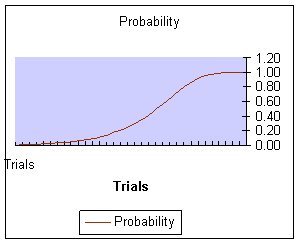
The following graph shows an illustration of this principle:
This graph represents the cumulative probability of an event with a one-in-a-million chance of occurring in one year, taken cumulatively over a ten-thousand to a ten-million year interval. So the left edge of the graph represents ten-thousand years, and the right edge is the ten-million year mark. The cumulative probability of the event is shown to rise from just slightly above zero to just slightly below one over this interval. The detail of the image does not fully capture this well, but the probability of this event occurring within a ten million year interval is not one, it is 0.99995460029725. Now were the graph to represent an actually infinite span of time, then any event, no matter how small its probability, will attain virtual probabilistic certainty of obtaining. No number greater than zero can be small enough to exhaust the probabilistic resources of an actually infinite interval.
Mathematically, here's how it works. The probability of an event for a desired interval (or number of trials) can be calculated if you know the probability of that event for a denominator of that interval (or number of trials). So, you can figure the odds of an event happening within ten years if you know the odds of it happening in one year. For example, you can figure the odds of rolling a six with a die within 100 rolls if you know the odds of doing it in one roll. You figure it out like this: Let K represent the interval or number of trials for which the odds of the event are known, and let O represent the odds of the event within that known interval or number of trials. Then let D represent the interval or number of trials that you desire to know the probability of rolling a six within (D must be in the same units of measure as K). Subtract the odds O from the known interval K, divide that result by the known interval K, raise that result to the power of the desired interval D, and subtract that end result from one.
Algebraically, it looks like this:
Probability = 1 - (((K-O)/K)^D).
Try this on a mundane example, and you'll see something like this: To figure the odds of rolling a six within ten rolls of a die, you'd know that for one try (K=1), the odds are 1/6, or ~0.166667, so O = 0.166667. The number of trials that we desire the probability for is 10, so we'll use that number for D, and find out that the odds of rolling a six within ten tries are about 84%.
Probability = 1 - (((1-0.166667)/1)^10) = 0.838494417, or roughly 84%.
To get a feel for how this works with more esoteric examples, consider that an event with only a 0.00000000001 chance of happening per year will achieve a probability of 0.999954600107804 in one trillion years. In this example, the "one trillion" is D - the power to which the number is raised before subtracting it from one. Since the previous result ((K-O)/K) is a fraction, each power it is raised to reduces the number instead of increasing it (as in 1/2 ^ 3 = ~1/8, because 1/2 * 1/2 = 1/4, 1/4 * 1/2 = 1/8, etc.) So what is happening here is that the larger D is, the more vanishingly small our product becomes before subtracting it from one. But if the past is truly beginningless, then we have an infinite quantity being plugged into D. This means that our result isn't rational; it's 1 minus (an irrational, infinitely small number), which gives us an irrational result that's infinitely close to 1. No number we can actually represent is as close to one as the probability of an event given infinite time if it has a nonzero probability given finite time. For the sake of simplicity in notation, I will simply represent this as P = ~1 later in the argument.
Whereas Craig draws out the implications of the positive probability of such an interval, I want to draw out the implications of the negative probability, i.e. the probability that the fact will fail to be actual. To do this, let's explore the impact of this aspect of probability and the classical argument from contingency. First, I will provide a few definitions regarding modal logic and mereology (here I am loosely following Robert Koons's formulation [2]):
- Fact: An entity, state of affairs or event that can participate in causal relations (i.e. can be a cause or effect).
- Necessary Fact: A fact all of whose parts of which must be actual in all possible worlds/states/times, etc. A fact for which it is metaphysically impossible to be non-actual.
- Contingent Fact: A fact none of whose parts are necessary, which can possibly either be actual or non-actual.
- Asymmetry, Non-circularity and Identity conditions of causal relationships: A cause may not be identical to its effect, a cause may not overlap its effect in terms of having a common part, and causal propagation may not travel in a fashion contradictory to causal priority. For example, even if we assume that time travel is possible, it would remain impossible for Mary to give birth to a daughter who gives birth to a granddaughter who in turn gives birth to the same Mary.
- Fusion Principle of Mereology: If there are any facts of type Ø, then there is also an aggregate or sum of all the Ø facts which is itself an Ø fact.
- Cosmos or Universe: In our present context, I am using "cosmos" and/or "universe" interchangeably to refer to the sum of all contingent facts which are actual.
- Metaphysical Determinism: The proposition that there are no contingent facts essential to the actual world.
- Operators and Symbols:
The "P(x)" symbol denotes "Probability of x";
The "pipe" operator..." | " ...denotes "given";
Finite intervals are represented by " ƒi ";
The term "not" is represented by a " ¬ ";
Infinite intervals are represented by " ∞i ".
The tilde operator " ~ " represents approximation (infinitely close approximation in our case).The probability theorem and its consequence can now be expressed as:
- If [P(E|ƒi) > 0],
- Then [P(E|∞i) = ~1]
I now want to show that Craig's third method can secure the same conclusion - that statistical probabilities prohibit the past from being infinite - by using it in an inverse manner. To accomplish this, I will be joining his method with elements of the argument from contingency. In my estimation, Craig's conclusion is secured more strongly by this method than by joining a probabilistic argument with an observational one as he does. In saying that, though, I should note that I am talking about intuitive strength here, not logical force; I have yet to see a convincing refutation of Craig's own version of this, and lacking that, there would be little need for him to revise his manner of use to accommodate my intuitions! My conclusion, though, is that unless metaphysical determinism is true, then the universe or cosmos must have begun to exist.
My proof follows:
- For any contingent fact X, [P(¬X|ƒi) > 0]: The probability of X being non-actual (i.e. the probability of "not-X"), given a finite interval, is greater than zero.
- If there are any contingent facts that are actual, then there is a sum or aggregate of all the contingent and actual facts ("C"), and this aggregate is itself a contingent fact.
- If there are any contingent facts, then [P(¬C|ƒi) > 0]: that is, the probability is greater than zero for the aggregate C to be non-actual given a finite interval.
- If the set of past events is actually infinite, then [P(¬C|∞i) = ~1], where ¬C represents "not C", or C being non-actual, and ∞i represents an infinite interval. In other words, there must be a state void of contingent facts within an actually infinite past.
- For one or more contingent facts to arise from a state which is void of contingent facts is tantamount to a beginning.
- Therefore, given an infinite past, the cosmos (the sum of all contingent facts which are actual) must have had a beginning.
Justification of proofs:
Premise 1 This is a direct consequence of failing to be a necessary fact. Since if it is by definition possible for any contingent fact to be non-actual, then the probability of the fact being actual or non-actual must be greater than zero.
Premise 2 is a consequence of the fusion principle of mereology. Additionally, it is demonstrable that contingency is an associative property with respect to aggregates of concrete facts. Regardless of interdependence relationships that may exist between contingent facts, any aggregate composed entirely of facts with a P(E|ƒi) > 0 cannot have a zero-probability of E in toto. This is to say that if none of the members of some sum of facts are individually necessary, then no two, three, (...n) of the members taken together will be necessary, even if we were to posit that one member's actuality were necessary given another member's actuality.
Premise 3 Follows immediately from premises 1 and 2.
Premise 4 Is a consequence of the theorem [P(E|∞i) = ~1] on the result of Premise 3.
Premise 5 Quite simply rests on the equivalence of "beginning to exist" with a situation where {a state void of a thing} precedes {a state which is not void of that thing}. This should be uncontroversial.
Premise 6 The conclusion is entailed by the conjunction of premises 4 and 5.
Objections:
- Necessity and contingency aren't real categories of existence, they are just abstract logical designators.
Reply: This objection is ignorant of the sizeable contributions of modal logic to physics, philosophy, cognitive theory and the sciences in general. But assuming it was correct, then one of the following would have to be true - either everything must be as it is (i.e. everything is necessary), or everything may be as it is but could have been otherwise (i.e. everything is contingent). This disjunction is collectively exhaustive, so if neither of the the disjunctive formulas hold, then we're back at modality being real. Now if everything is contingent, then the argument here still applies. So the only force this objection could have is if everything is necessary, i.e. metaphysical determinism is true. The cost to our current knowledge in the empirical sciences and in philosophy would be enormous if this is true. On the contrary, there are myriad independent reasons for rejecting wholesale determinism. Since those reasons are beyond the scope of this article, I will for the time being grant that the determinist has a temporary logical escape from the force of my argument.
- We can readily conceive of an infinitely old universe which maintains a certain state in which lots of things don't happen. Are you saying that such a universe is not a possible world?
Conceivability is not equivalent to physical, metaphysical or logical possibility. M.C. Escher, for instance, could not only conceive of things that were in one way or another impossible, he could visually represent them too. We would not conclude from this, though, that everything Escher could conceive will become actual given an infinite interval. So, we can even conceive of fairies or Casper the Friendly Ghost hatching from platypus eggs if we like, but this does not count as qualification that these really are potential contingent phenomena. Determining which of our conceptions are actually metaphysically possible is a difficult chore -- perhaps even an intractable one. For this reason, I prefer my negative probabilistic argument over positive versions of it. The reason for this is because we know that all phenomena which actually do exist truly are possible. Further, we also know that nearly all if not all phenomena we are acquainted with can fail to exist. So unlike arguments that quibble back and forth about possible worlds, I merely take phenomena that we are already fairly certain can possibly exist and can possibly fail to exist, and reason from the properties that we can observe operating on those known phenomena in the actual world. If worlds where the statistical properties of our world don't hold are possible worlds, then I suppose some sort of state-maintaining system of infinite duration could certainly exist. But this argument is about the actual past of our actual world, where the naturalist must hold that that (P > 0) for our cosmos, galaxy, solar system, planet and biosphere to come into existence. So we can't just do away with the possibility of state-change. Thus, while I'm not necessarily saying that such a universe as you posit isn't a possible world, I am saying that it is not a possible history of our actual world given an infinite past.
- The theorem [P(E|∞i) = ~1] doesn't nearly provide the warrant to secure the extraordinary conclusion that everything that can possibly happen has actually happened.
Well, it is statistically true that whatever is really possible (P > 0) must indeed happen given an infinite interval, which in turns means that everything that can happen must have already happened in an infinite past - and probably more than once! If that consequence is logically objectionable, consider this. If we combine the statistical regularities that have been observationally confirmed for finite intervals with the assumption of an infinite past, and paradoxes, absurdities and strangeness results, we have two choices: Doubt that our empirically-gathered information about statistics is valid, or doubt that the past is infinite. But the former bit of data has independent confirmation, whereas the latter assumption does not. So it would seem difficult at best to epistemologically justify preferring the former option to the latter, if one or the other has to go. If we don't discard the statistical properties that are confirmed within the intervals we can observe, then we are stuck with a probability for any possible event that is indistinguishable from 1. It is far greater, for example, than .9 with a hundred trillion more 9's after it, or even than with 10^1,000,000 more nines after it. If the true believer in an infinite past wants to hang his or her hat on the literally infinitely small difference between 1 and the actual P(E), he or she can have at it, and I'll be content with our respective numbers on the probabilistic scoreboard.
Conclusion:
There are many correlated issues to this argument, such as the actuality of a Necessary Fact, the manner in which a Necessary Fact can bring about the actuality of contingent facts, or how the paradoxes that a "first event" presents can be understood coherently. These are interesting questions, and we fully intend to explore them in future articles. For now, our simple conclusion is this: The assumption of an infinite past leads us to a paradox: It probabilistically guarantees that the cosmos has a beginning. Unless the universe contains no contingent facts essentially and thus metaphysical determinism is true, then the universe must have begun to exist.
[1] William Lane Craig, 1996
Internet Transcript: Debate between William Lane Craig and Quentin Smith,
http://www.leaderu.com/offices/billcraig/docs/craig-smith1.html[2] Robert Koons, 1997
A New Look at the Cosmological Argument,
American Philosophical Quarterly 34 (1997):193-212
http://www.utexas.edu/cola/depts/philosophy/faculty/koons/cosmo.pdf